Archive for the ‘Health’ Category

TORIES INVEST IN CAPE BRETON

MacKay announces funding for geothermal arena project

Defence Minister Peter MacKay at Centre 200

Defence Minister Peter MacKay wears a Cape Breton Screaming Eagles jersey and baseball cap during an announcement at Centre 200 in Sydney on Wednesday. Chris Shannon – Cape Breton Post

Published on February 16, 2011

Published on February 16, 2011

Chris Shannon 

SYDNEY — A Glace Bay community group is getting assistance from the federal government to move forward with its $997,000 energy-efficient geothermal heating and cooling system pilot project at the Bayplex.

Topics :

Centre 200 , Enterprise Cape Breton , First Nation , Sydney , Cape Breton , Nova Scotia

The energy for the system will come from mine water from the community’s former coal mines for heating and cooling purposes, the arena’s general manager Clarence Routledge said during Wednesday’s funding announcement at Centre 200 in Sydney.

“It’s a tremendous, tremendous project,” Routledge said.

“What it will do for the environment, in reducing greenhouse gas emissions, it is equal to taking 200 vehicles off the road.”

 Defence Minister Peter MacKay said the federal government would contribute $272,498 to the project through its local economic development agency Enterprise Cape Breton Corp.

“This is tremendous innovation being brought to bear here in Cape Breton,” said MacKay, who is also regional minister for Nova Scotia.

“This will result in significant energy savings for the facility.”

The Bayplex geothermal system will also serve as a pilot project for other geothermal energy applications that may lead to further developments in Cape Breton, Routledge has said.

According to Routledge, a similar system is in use at the Springhill arena and yearly energy costs at the Bayplex are about $192,000 compared to $94,000 for the arena in Springhill.

Membertou was also the recipient of federal investment dollars with $2.3 million to support the First Nation’s hotel construction project that’s currently being built. The money acts as a loan to the joint venture company Charlottetown-based DP Murphy Inc., which is building the Hilton-brand 124-room hotel.

“The Murphys are investing in over $9.8 million into the project. That investment would not have been possible without the facilitation and assistance of Enterprise Cape Breton Corp.,” said Membertou senior adviser Dan Christmas.

“All the projects we do in Cape Breton are based on co-operation and good, sound assistance and I can honestly tell you, Mr. Minister, that the assistance that was provided to us by ECBC was instrumental in bringing in an outside Maritime investor into the Sydney area.”

MacKay also lauded the accomplishments of Centre 200 and the $3.75 million the federal government has already contributed to major upgrades to one of the largest arenas in the province.

He said the upgrades would put the Cape Breton Screaming Eagles in good stead in awarding the 2012 Memorial Cup to Sydney. Halifax, Saint John, N.B., and Shawinigan, Que. are also bidding for the tournament.

“These investments were designed specially to increase economic development and impact on the facility itself by positioning Centre 200 and the CBRM as a potential venue for regional, national, and international sports and cultural events,” MacKay said.

And being a good sport, the minister, a hockey fan, wasted little time in promoting the Eagles’ Memorial Cup bid by removing his jacket and pulling on a Cape Breton Screaming Eagles jersey over a white dress shirt and plaid tie. He didn’t forget to put on the matching Eagles baseball cap, all of which caught the attention of camera crews and journalists.

The completion of construction along the Cabot Trail was also announced.

A Parks Canada news release stated $29.6 million had been spent on infrastructure projects, of which $14 million was provided through funding from Canada’s economic action plan.

The Liberal are viewing these announcements in the regions as a public relations exercise prior to a potential election call.

In a release, Sydney-Victoria Liberal MP Mark Eyking called it a “rehash of old announcements” and that it’s an indication that the “federal spending well has run dry.”

“For a minister to leave Ottawa on a Wednesday you would think there would be a new project,” Eyking said.

“I was hoping he would at least announce a new federal building for Ingonish after the Conservatives have stalled the project for four years.”

MacKay’s visit to Cape Breton was hampered by poor driving conditions, forcing the cancellation of his 11 a.m. event at the Sydney cruise pavilion, which would have focused solely on infrastructure improvements to the Cape Breton Highlands National Park.

(cshannon@cbpost.co)

DO YOU REMEMBER – 19


The Corset – Ouch

Hey do you remember the corset which eventually led to the brassiere for Ladies? Do you know that the first brassiere did not appear on the market until 1914? And then it took many years before they became acceptable, popular and even available to the average lady in need of one. Let us ‘explore’ the corset and the brassiere in the following paragraphs. You might, as I did, find the topic to be fascinating.

History of the corset – A corset is a close-fitting piece of clothing that has been stiffened by various means in order to shape a woman’s torso to conform to the fashionable silhouette of the time. The term “corset” only came into use during the 19th century; before that, such a garment was usually referred to as a pair of bodies, a stiff bodice, a pair of stays or, simply, stays. In French 18th century texts you can find the term corset as a lightly stiffened bodice with tie-on sleeves, whereas proper stays are called corps.

The origins of the corset are unknown. From the early 16th century, corset-shaped cages of iron are preserved, but it’s almost certain that they had nothing to do with normal clothing. Theories run from early fetish accessories to brute attempts at orthopaedics. Judging from contemporary depictions, stiffened bodices must have been worn around 1530 because the straight, conical line of the torso seen e.g. in portraits of Venetian ladies or Eleanora di Toledo could not have been achieved otherwise. The neckline is relatively high and the chest pressed flat rather than pushed up.

The Corset – Better

In the 18th century, stays are definitely underwear. Only in case of the Robe à l’Allemande, the stiff bodice survived until about 1730, in case of the French court robe even longer. The shape of stays is not much different from that of the 17th century: Conical, pressing the breast up and together, with tabs over the hips. The tabs are formed by cuts from the lower edge up to the waistline that spread when the stays are worn, giving the hips room. They prevent the waistband of the skirt from crawling under the stays, and the waistline of the stays from digging into the flesh.

There are stays that lace at the back and those that lace across a stiff stomacher in front Examples that lace both back and front (but not over a stomacher) are quite rare. Stays that lace in front only are even rarer and so far only known from the region of Southern Germany. In all these cases, spiral lacing is used.

From 1794, the waist moved higher and arrived just under the bust around 1796. A new kind of corset is needed: The torso, hidden under flowing muslin, doesn’t need shaping anymore. The breasts still need lifting, but they’re supposed to stay apart. To achieve this, cups are employed for the first time. The busk, which in the 17th century had served to keep the front of the stays straight, now came back into use to keep the cups apart. The shape follows the natural form of the body and widens over the hips by means of triangular inserts.

The Corset – Oops

Since slender figures could keep the bust in shape with the help of only a firm bodice lining, it is mainly stout and over-endowed ones who wear corsets or short stays which already looked like early bras. Therefore, not many corsets from that time have been preserved. Unlike the earlier ones, they tend to be plain and functional. Maybe the fact that they contained less boning led people to refer to them by the (French) term for lightly boned bodices, corset. This is just a theory, but it would explain why the earlier term corps/stays had been replaced with corset by the 1820s.


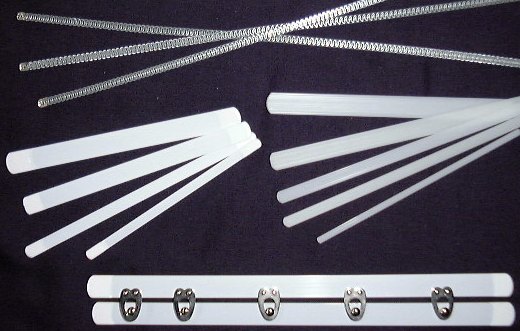
When the waist moves back to its natural place during the 1820s, corsets become more popular again. Until the 1840s, well-shaped figures can do without one without drawing looks. In 1828, lacing eyelets with hammered-in metal grommets are invented (until then, eyelets had been stitched). A year later, the planchet came in: Two metal strips, one with little mushroom-shaped heads, the other with eyelets, used to close and open the corset in front without having to undo the lacing every time. This busk, as it is called in English, makes it possible to change the lacing completely: Both ends of the cord are threaded through the eyelets crosswise and knotted together at the end. At waist level, one loop is formed on either side and used to pull the lacing tight. This kind of lacing is still used today.

Around the middle of the 18th century, corsets become mandatory again. The shape is already the famous hourglass that we associate with corsets today. While tailors still experiment with complex, strange and unusual patterns – the shape is still relatively new, after all – the look stays rather plain. From about 1860, when some patterns have caught on, more emphasis is placed on beautiful fabrics and elegant lines again. From the years around 1870-90, a large number of meticulously made corsets has been preserved, partially embroidered and with satin top fabric in various of colours.

Until c. 1870, the crinoline hid anything from the waist down, so corsets ended not much below the waist. Later, dresses closely hug the figure at least in front, so corsets become longer. This development reached a peak around 1880, when the fashionable silhouette hugged the hips on all sides. The belly is tamed, but not flattened, by a new kind of busk: The pear-shaped spoon busk (see right corset in the picture above) bends inwards to compress the stomach region, then outwards over the belly, an in again over the lower abdomen. If laced tightly, a spoon busk forces the soft bits (i.e. fat as well as inner organs) downwards – and during the 1890s, tight-lacing becomes so popular that physicians sound the alarm again.


This unnatural posture makes the originally well-meant corset even more uncomfortable and harmful than any before, causing much damage to the musculoskeletal system. It reaches way down around the hips and for the first time and has long elastic strips sewn to the lower edge with clips on the end to hold the stockings up. Since there still is a long shift between the corset and the stockings, the shift must be pulled and bunched up to fasten the clips to the stockings – yet another source of discomfort that may have led to the demise of first the shift, then the corset. 

The rise of women’s lib, the rational dress movement and progressive designers saw to it that this fashion did not prevail for long: Even before the beginning of WWI, the corset has begun its downslide. Fashion now permits women to wear elegant dresses without a corset. Nevertheless, corsets were still worn for a few years more, but both the S-line and tight-lacing disappear. Elastic inserts give more room for movement – and they have to, because post-1910 corsets reach so far down that they would otherwise prevent the wearer from sitting and walking. The so-called war crinoline (1915/16) with its high waists and flared skirts made even those unnecessary.


1920s to 1950s – One could say that the corsets slid downwards and became more elastic. The straight, waist-less Garçonne fashion of the 1920s favoured only lightly stiffened hip girdles partly made of elastic. They were not supposed to constrict the waist, but to control the belly and hips. The chest was supported (and, if necessary, reduced to a boyish look) by a bra. Girdle and bra persevered through the 30s and 40s as well.

Men’s Corsets

It was Dior’s “New Style” that put the waist back onto centre stage. His models emphasise an extremely small waist and wide hips, so that corsets, or at least a watered-down version of them, see a short-lived renaissance. In the 1950s, elastic girdles without any boning come back, only to be washed away by the flower-power 60s and 70s.

Today – Corsets have probably been worn for erotic purposes during all that time, even while they had been gone from fashion. Only in the 1980s, Madonna brought them back into public attention with the help of her favourite designer, Gaultier – as top garment. Her version, however, was more like a tight bodice than a proper corset. Nowadays, real corsets are only rarely worn. Sometimes a celebrity or lover of historical fashion may wear it visibly as a fashion statement, but mostly, it still is worn underneath for erotic reasons. Whether they be waist-cinchers, under-bust, half-bust or full-bust: The basic shape is still the same as 1860-80, only that they usually don’t compress the waist nearly as much.


Male in decorative Corset

Most legends of course are about impossibly small waists. The “oldest” and most extreme one is the one that asserts that Katerina de’ Medici, Queen of France in the late 16th century, required her ladies-in-waiting to have 13 inch waists. Someone who doesn’t use inches in everyday life will first try to convert that into centimetres and then start to wonder which inch they should use since there were so many different units of that name.

Some early photographs show women – mostly actresses – with extreme waists. In some cases, the rigid, artificial-looking posture shows that this was not their normal state. Retouching was used extensively in those days and brought forth masters of the art. Porn photographs of the time show women who would not be considered slender by modern standards. Sometimes you find quotes from late 19th century magazines reporting that a lady died after having taken a fall in the street. A broken rib was pressed inwards by the tightly laced corset, causing it to puncture a lung or the liver. I have even seen a contemporary magazine which reported the story and therefore believed it – until I found the same story, slightly altered, quoted from a different magazine, from a different year. I am now convinced that we’re dealing with an urban legend.

More Comfortable

The Brassiere – “When I made my debut,” recalled Caresse Crosby in her autobiography, The Passionate Years, “girlish figures were being encased in a sort of boxlike armor of whalebone and pink cordage. This contraption ran from the knee to under the armpit. Over the top of it was hooked a corset-cover of muslin or silk.”

Although she would later gain a reputation as a sexually liberated woman, Caresse Crosby did not invent the brassiere in order to promote a sample of what would become her chosen name. One evening her bulky corset-cover was showing over her décolletage as well as hampering her freedom of movement. She demanded two silk handkerchiefs, a length of pink ribbon, and a needle and thread from her maid and constructed the first modern bra on the spot. It was not a lifting and shaping types that would later be designed but rather a way to squash the bust line flat against the chest, as was considered proper for an unmarried lady of the day.

The backless brassiere was a relief from her confining undergarments. She showed it to her friends in secret and they begged to have one also. She hired a patent lawyer and set about securing rights to the backless brassiere. A US Patent was granted in 1914. After her attempt to sell her bras to the finer stores of New York failed a family friend offered to negotiate the sale of the patent to the Warner Brothers Corset Company. When she was offered $1500 for it she thought it a magnificent sum and sold. Estimates are that Warner made $15 million from the invention over the next 30 years.

Much much Better

(Thus was the introduction of the brassiere or bra. I often wondered why in God’s name did they put the @#%$* snap at the back and out of reach under most circumstances. CAPER)


THE INVISIBLE MOTHER

Typical Mother with Children in the Hungry 30’s 

(I find this story to be beautiful and truthful and it brings shame into my heart. How many times have I as a youngster done the same thing and took my mother for granted. I remember to this day the shame I felt [still feel] when i whined and ranted about the shrinking of my Maple Leaf sweater in too hot water and I later found her crying. [I knew that I caused her to cry] To this day I didn’t apologize yet it haunts me still that I was so callous and never took the time to say I was sorry, and of course now it is too late. And her with no water in the house, it had to be carried from a well some distance away and heated on the top of the coal stove, the washing machine was a tub and washboard. She also had a couple of babies and four or five of my sisters and a brother to cater to and not even the luxury of an inside toilet or running water. CAPER)


This is one of the nicest stories I’ve taken the time to read.

Invisible Mother…..

It all began to make sense, the blank stares, the lack of response, the way one of the kids will walk into the room while I’m on the phone and ask to be taken to the store. Inside I’m thinking, ‘Can’t you see I’m on the phone?’

Obviously not; no one can see if I’m on the phone, or cooking, or sweeping the floor, or even standing on my head in the corner, because no one can see me at all. I’m invisible. The invisible Mom. Some days I am only a pair of hands, nothing more! Can you fix this? Can you tie this? Can you open this??

Some days I’m not a pair of hands; I’m not even a human being. I’m a clock to ask, ‘What time is it?’ I’m a satellite guide to answer, ‘What number is the Disney Channel?’ I’m a car to order, ‘Right around 5:30, please.’

I was certain that these were the hands that once held books and the eyes that studied history and the mind that graduated summa cum laude -but now, they had disappeared into the peanut butter, never to be seen again. She’s going, she’s going, she’s gone!?

One night, a group of us were having dinner, celebrating the return of a friend from  England . Janice had just gotten back from a fabulous trip, and she was going on and on about the hotel she stayed in. I was sitting there, looking around at the others all put together so well. It was hard not to compare and feel sorry for myself. I was feeling pretty pathetic, when Janice turned to me with a beautifully wrapped package, and said, ‘I brought you this.’ It was a book on the great cathedrals of  Europe . I wasn’t exactly sure why she’d given it to me until I read her inscription: ‘To  Charlotte , with admiration for the greatness of what you are building when no one sees.’

In the days ahead I would read – no, devour – the book. And I would discover what would become for me, four life-changing truths, after which I could pattern my work: No one can say who built the great cathedrals – we have no record of their names. These builders gave their whole lives for a work they would never see finished. They made great sacrifices and expected no credit. The passion of their building was fueled by their faith that the eyes of God saw everything.

A legendary story in the book told of a rich man who came to visit the cathedral while it was being built, and he saw a workman carving a tiny bird on the inside of a beam. He was puzzled and asked the man, ‘Why are you spending so much time carving that bird into a beam that will be covered by the roof, No one will ever see it. And the workman replied, ‘Because God sees.’

I closed the book, feeling the missing piece fall into place. It was almost as if I heard God whispering to me, ‘I see you, Charlotte. I see the sacrifices you make every day, even when no one around you does.

No act of kindness you’ve done, no sequin you’ve sewn on, no cupcake you’ve baked, is too small for me to notice and smile over. You are building a great cathedral, but you can’t see right now what it will become.  At times, my invisibility feels like an affliction. But it is not a disease that is erasing my life. It is the cure for the disease of my own self-centeredness. It is the antidote to my strong, stubborn pride.

I keep the right perspective when I see myself as a great builder. As one of the people who show up at a job that they will never see finished, to work on something that their name will never be on. The writer of the book went so far as to say that no cathedrals could ever be built in our lifetime because there are so few people willing to sacrifice to that degree.

When I really think about it, I don’t want my son to tell the friend he’s bringing home from college for Thanksgiving, ‘My Mom gets up at 4 in the morning and bakes homemade pies, and then she hand bastes a turkey for 3 hours and presses all the linens for the table.’ That would mean I’d built a shrine or a monument to myself. I just want him to want to come home. And then, if there is anything more to say to his friend, to add, ‘You’re going to love it there.’

As mothers, we are building great cathedrals. We cannot be seen if we’re doing it right. And one day, it is very possible that the world will marvel, not only at what we have built, but at the beauty that has been added to the world by the sacrifices of invisible women.

Great Job, MOM!

Share this with all the Invisible Moms you know… I just did.  The Will of God will never take you where the Grace of God will not protect you.  This is beautiful and makes a ton of sense. To all the wonderful mothers out there.

~~~~~~~~~~~~~~~~~~~~~~~~~

I am in much debt to my invisible Mother.

PS.  Remember her far away glance when she doesn’t. Remember the childlike glee when you arrive and the sad understanding when you leave.  Try calmly to remember for her when far too memories cannot be sorted out.  Remember.

 Taking a Taxi to the Doctor – 1938

(Article contributed by Jack Hare, LCdr USN – old navy buddy- CAPER)

NEW YEAR’S LEVEE AND MOOSE MILK

(Many of you may be planning on attending a New Year Levee put on by the Governor General, Lieutenant Governor, Local Garrison Commander or your Mayor. In any event a quick review of the contents below will better arm you with some background on this popular event. CAPER)

Pipe in the Lt Governor – WEST COAST

The annual New Year’s Day Levée, is traditionally hosted by the Governor General, the Lieutenant Governor, military establishments, municipalities and other institutions, and has an unusual and interesting origin.

The word Levée is derived from the French verb lever — to rise (specifically from one’s bed) — and has its origins in the Levée du Soleil or Rising of the Sun instituted by King Louis XIV (1643–1715) whose custom it was to receive his male subjects in the Royal bedchamber just after arising, a practice which subsequently spread throughout Europe.
The Levée crossed the English Channel in the 18th Century, and in Great Britain and Ireland became a formal Court assembly (reception) given by the Sovereign or his/her representative in the forenoon or early afternoon, at which only men were received.
In the New World colonies, the Levée was held by the Governor acting on behalf of the Monarch. Because settlers were widely scattered, and separated from the seat of Government, the annual Levée was a very important event, and attendance by village leaders and public dignitaries was compulsory.

It was in Canada that the Levée became associated with New Year’s Day. The holding of a Levée by the Governor General and Lieutenant-Governors on New Year’s Day is not a continuation of the precedent set by the Sovereign they represent, but rather perpetuates an ancient custom of this country, dating from the days of the fur trade. The people of the trade traditionally paid their respects to their representative of government — the Master of the Fort — on New Year’s Day.

The first recorded Levée in Canada was held on January 1st, 1646 in the Chateau St. Louis by Charles Huault de Montmagny, Governor of New France (later Québec) from 1636 to 1648. In addition to shaking hands and wishing a Happy New Year to citizens presenting themselves at the Chateau, the Governor informed guests of significant events in the Mother Country, as well as the state of affairs within the colony. (This tradition is carried on today within The Commonwealth in the form of The Queen’s New Year’s Message. The State-of-the-Union address by the President of the United States, although not delivered on New Year’s Day, has similar origins.) In turn, the settlers were expected to pledge anew their allegiance to the Crown.

The Levée tradition was continued by British Colonial Governors in Canada, and subsequently by Governors General and Lieutenant-Governors, and continues to the present day.

Records suggest that only after British Columbia entered Confederation in 1871 were Levées regularly held by the Lieutenant-Governor of the Province, and that Colonial Governors of Vancouver and (Mainland) British Columbia did not customarily hold them on New Year’s Day. The (Victoria) Colonist of January 3rd, 1872 reported that “… His Excellency the Lieutenant-Governor (Sir Joseph J.W. Trutch) and family received and entertained many callers at their private residence”. Subsequent Levées were held, for the most part, in Government House.

Although receptions hosted by the President of the United States of America are occasionally referred to as Levées, over the years, the Levée has become almost solely a Canadian observance.

Today, the word Levée describes the receptions (usually — but not necessarily — on New Year’s Day) held by the Governor General, the Lieutenant-Governors of the Provinces, the Military, and others, to mark the advent of another year and to provide an opportunity for the public to pay their respects.

The Levée has a long tradition in the Canadian Forces as one of the activities associated with New Year’s Day. In years past, Military Commanders garrisoned throughout the vast expanse of Canada held local Levées since, as Commissioned Officers, they were expected to act on behalf of the Crown on such occasions.

On the West Coast, Levées are a well-established tradition, given that Vancouver Island was the base for the Royal Navy’s Pacific Fleet, beginning in the 1840s.

Today, as in bygone years, members of the various Canadian Forces units and Headquarters across Canada receive and greet visiting military and civilian guests in the convivial spirit of the first day of the new year.

As has the Levée itself, refreshments served at Levées have undergone change — in importance and variety — over the years.

In colonial times, when the formalities of the Levée had been completed, guests were treated to wine and cheeses from the homeland. Wines did not travel well during the long ocean voyage to Canada; so, to make the cloudy and somewhat sour wine more palatable, it was doctored with alcohol and spices, and heated. The concoction came to be known as “Le Sang du Caribou”, or Moose Blood.

Under British Colonial rule, many of the customs of French Canada were retained but, in the case of “Le Sang du Caribou”, whisky, which traveled better, was substituted as the basic ingredient. This was then mixed with goat’s milk, and flavoured with nutmeg and cinnamon to produce an Anglicized version called “Moose Milk”. Today’s version of Moose Milk, in addition to whisky (or rum) and spices, uses a combination of egg-nog and ice-cream and sometimes an additional alcoholic refinement or two.

Refreshments were clearly an important element in the New Year’s festivities. A report of the New Year’s Levée held in Brandon House in Manitoba in 1797 indicated that “… in the morning the Canadians (men of the North West Company) make the House and Yard ring with saluting (the firing of rifles). The House then filled with them when they all got a dram each”. Simpson’s Athabasca Journal reports that on January 1st, 1821, “the Festivities of the New Year commenced at four o’clock this morning when the people honoured me with a salute of fire arms, and in half an hour afterwards the whole Inmates of our Garrison assembled in the hall dressed out in their best clothes, and were regaled in a suitable manner with a few flaggon’s of Rum and some Cakes. A full allowance of Buffalo meat was served out to them and a pint of spirits for each man”.

Place leftovers in a Jug for Later

Indeed, when residents called upon the Governor to pay their respects, they expected party fare. On Vancouver Island, there was “an almighty row” in 1856 when the Colonial Governor’s Levée was not to their liking.

In military messes, hospitality is dispensed in a variety of forms, from the previously-mentioned Moose Milk (with rum often substituted for whisky), and the special flaming punch of the Royal Canadian Hussars of Montreal — a concoction bequeathed to the regiment by the old 1st Motor Machine Gun Brigade, and requiring a month to prepare — to the famed Athole Brose, the brew of oatmeal, honey and whisky of the Seaforth Highlanders of Canada, Vancouver.

Historically, the Levée has been largely a male preserve having its origins, as previously mentioned, in the Royal bedchamber. This custom persisted, in part, because of societal practices of earlier days, and quite possibly the fact that it was an occasion enlivened by quantities of rum or other spirits, and thus was often a raucous celebration.
During the Second World War, Levées were attended by female officers of the Armed Forces, and since then the “men only” tradition has given way to Levées attended by both men and women.

From the rather boisterous celebrations of early times to the somewhat more sedate, if informal, event of today, the Levée has evolved into an occasion to call upon representatives of the Sovereign, military, and municipal governments, to exchange New Year’s greetings and best wishes for the coming year, and to renew old acquaintances and meet new friends in a convivial atmosphere. It is also an opportunity to reflect on the events of the past year and to welcome in the challenges and opportunities of the New Year.


Navy Moose Milk
This is a tradition of the Canadian Navy. It was basically the last minute findings found in the cooks galley to mix with the leftover alcohol. Mixed in a big batch in the big mixing bowl. Though other branches of the military service (army, air force, RCMP) claims to have the original or best, don’t be fooled! Navy comes out on top!

1 gal. vanilla ice cream
1 pot cold coffee
1/2 gal milk
micky of vodka
micky of dark rum
micky of kaluha
dark chocolate pieces

New Year’s Levee Government House – EAST COAST

MOOSE MILK Warning – Within anything from a few minutes to an hour after imbibing on Moose Milk you will begin to feel the benefits. Initially a mild feeling of euphoria will overtake you as your metabolism increases its efficiency. Within a very short period thereafter, you will note various other benefits including a massive increase in confidence, pride, intelligence and magnetism to the opposite sex. There are only two possible negative side effects and they can be avoided by following these warnings:
1. If you feel the urge to paw the ground and run head long into a member of the opposite sex? Resist.
2. Despite the strong cravings you will undoubtedly feel for more moose milk, under no circumstances should you attempt to milk a moose on your own; this job is strictly for the professionals.
Another recipe:
20 LITRES WHITE MILK
16 LITRES VANILLA ICE CREAM
1 X 40 OZ VODKA
2X 40 OZ DARK RUM (CAPTAIN
MORGAN)
1 X 40 OZ WHITE RUM
1 X 40 OZ TIA MARIA
NUTMEG TO TASTE

Army Moose Milk:
40oz Lambs Dark Rum
40oz Kahlua
40oz Vodka
4L Vanilla Ice Cream (the good creamy expensive kind)
4L eggnog

Mix all together, breaking up the ice cream a bit. Sprinkle nutmeg on top if you so desire. Stir occasionally as the ice cream starts to melt. Enjoy!
OR:
1.14 lt of Dark Rum
1.14 lt of Kahlua
1.14 lt of Vodka
4 lt of vanilla soft scoop ice cream
4 lt of partly skimmed milk

Mix gently until frothy, leaving a few ice cream chunks.
Liberally sprinkle with Nutmeg on top.

Of course, if you are missing some ingredients, feel free to make a ‘reasonable’ substitution.

I replaced the Dark Rum with Capt Morgan’s Spiced Rum and the Vanilla Ice cream with Cafe-Latte Gelato.
I guess Tia Maria can be substituted for Kahlua…….but I insisted on getting Kahlua so as to stock the bar.

Canadian Air Force:
Messes traditionally serve “Moose Milk” at their New Year’s Levees. This alcoholic concoction contains no moose milk whatsoever. The recipes vary, but tend to include eggs, sugar, maple syrup, cream, or ice cream, and some combination of rye whiskey and rum.
The Official (well…sort of) Recipe for RCAF Moose Milk
           
Anyways, here’s another Canadian recipe for Moose Milk – metric of course:
*    1 l rum
*    1 l Kahlua
*    1 l vodka
*    3 l vanilla ice cream (softened)
*    3 l 2% milk (just to be diet conscious)
*    chocolate pieces (break up a dark chocolate candy bar or two- this is the added secret moose poop garnish)
*    nutmeg
Stir together, leave in some lumps. Sprinkle nutmeg on top.
You may need to play with the proportions to suit your palate. It does make a lot, but that usually doesn’t seem to be a problem, somehow it gets used up. Can leave you with a bit of a hangover, probably all that milk. Or maybe it’s heading out for spicy food after – been there, done that.
I did find a blender recipe for the solitary drinker – the single moose:
*    1 oz. Dark rum
*    1 oz. White rum
*    0.5 oz. Kahlua
*    2 scoops Ice cream
*    nutmeg
Blend just until smooth, sprinkle with nutmeg. Repeat as needed, but I’m betting that before you know it you’ll have friends over encouraging you to fill the blender to the top and then you start looking for that old punch bowl. For either of these recipes, don’t drink near an open flame, and be careful when standing up suddenly. This tastes best on a cold winter’s day, but also works in warmer climes, to help Canadians brag about how cold it is back home.

Ladies and Gentleman; “The Queen God Bless Her”

(Initiated by Hector MacKinnon – a fellow Cape Bretoner of course – CAPER)

CAPE BRETON EGGNOG

Eggnog

Cheers – Enjoy

  • 6 eggs
  • 1 cup plus 1 tablespoon sugar
  • 1/2 teaspoon vanilla extract
  • 1/4 teaspoon ground nutmeg
  • 3/4 cup brandy
  • 2/3 cup dark rum (Captain Morgan for best flavor, but Myers will do or Bacardi)
  • 2 cups whipping cream
  • 2 cups milk

All liquids should be very cold. Refrigerate in advance.

Beat the eggs for 2 or 3 minutes with an electric mixer at medium speed until very frothy. Gradually beat in the sugar, vanilla and nutmeg. Turn the mixer off and stir in the cold brandy, rum, whipping cream and milk. Chill before serving. Sprinkle individual servings with more nutmeg.

Makes about 2-1/2 quarts.

(If you are expecting to serve more than the two people, then you will have to make more – CAPER)

DO YOU REMEMBER – 9

Royal Victorian Order


Hey, do you remember the Victorian Order of Nurses (VON) conducting visits to your home and to the homes of neighbours during childbirths, sick children, prolonged illnesses, palliative care etc? They wore their nurses cap and a long dark cape and their cars had the VON logo and name on the door. I mention their fine work because since getting out of the hospital back in April of this year the medical access people who visit me and provide medical assistance is the VON. At first it was a couple of visits per day, then daily, followed by weekly until now it is once every couple of weeks and I fear since I am doing all of the necessary medical procedures myself they will soon stop coming – in other words I won’t need them. They have provided a wonderful service. It is so strange to see them today because they don’t wear uniforms and some are in shorts, slacks and I swear some look like they are wearing pajamas but whatever they wear they are all very professional. – CAPER
…”The story of the Victorian Order of Nurses is a vital part of the very history of Canada itself – – of its early expansion and social development, and of its changing ideals through two world wars, a great depression and the introduction of new medical technologies…….As the century draws to a close, VON remains a Canadian treasure…..”
For over 100 years, VON has pioneered health services in Canada. We have a proud tradition of often being the first to identify emerging health and social needs, and then providing innovative services that meet those needs. That’s the way it’s been since the founding of the Victorian Order of Nurses for Canada.
In the Canada of the late 1890s, nurses, doctors and hospitals were desperately needed in remote areas and in rapidly growing towns and cities.

Lady Aberdeen (Wife of GG Lord Aberdeen) Founder and President of VON

Lady Aberdeen was a participant at the annual meeting in Halifax of the National Council of Women, where similar horror stories were exchanged by the women in attendance. In her autobiography, VON’s founder was later to write of this meeting:
” …many of the members told pathetic stories of cases where young mothers and children had died, whilst husbands and fathers were traveling many weary miles for the medical and nursing aid which might have saved them…”

Lady Aberdeen was chosen VON’s first president. When criticism from Canada’s medical establishment caused Parliamentary support to falter, she appealed to the children of Canada for help, writing to their schools about the need for nurses to care for sick people in their own homes:

VON Providing Home Care

“In the towns they will go to those who cannot now afford the care of trained nurses and often die for lack of it… ”
“On the prairies, in the forests, in mining districts – – everywhere throughout the country – – they will go hither and thither amongst our brave pioneers and bring help to these heroic people who are building up the future of this beautiful country amidst many hardships and privations…”

As part of her campaign to establish and solidify VON, Lady Aberdeen enlisted the help of Dr. Alfred Worcester, professor of hygiene at Harvard University and founder of the Waltham Training School for District Nurses in Massachusetts. He also encouraged Miss Charlotte Macleod, superintendent of the Waltham school, to come to Ottawa and help set up VON. Miss Macleod, a Canadian who had studied with the legendary Florence Nightingale, became VON Canada’s first chief superintendent.

VON’s first 12 nurses were admitted to the order at a ceremony in November 1897 – just a month before Queen Victoria granted the organization its royal charter. A few months later, in 1898, Charlotte Macleod directed the formation of a team of four nurses to accompany the Canadian Field Force – – an expedition of military and government officials, to the rough and ready scene of the gold rush then taking place in the Klondike region of the frontier Northwest.

On her rounds – Cap, Bag and Bike

These nurses’ exploits in providing care to the miners under the most difficult of conditions became one of the earliest epic tales in VON’s long and colorful history.
The first VON sites were quickly organized in the cities of Ottawa, Montreal, Toronto, Halifax, Vancouver and Kingston. In 1898, a VON “cottage” hospital was opened in Regina to provide care to pioneers and early settlers on the prairies.


During the aftermath of the horrific explosion of a munitions ship in Halifax harbour in 1917…through a deadly influenza epidemic in 1918, on through two world wars…a great depression…the advent of modern medicare and high tech’ medicine — VON has continued to innovate to meet the changing health care needs of Canadian society.

Prenatal education, well baby clinics, school health services, visiting nursing and coordinated home care programs have all had their earliest origins with VON! More recent initiatives include home-based palliative care, adult day programs, foot care clinics, respite care, primary health care clinics and health services in shelters for women, children and youth at risk.

Today’s VON delivers its more than 75 different programs and services through 52 local sites staffed by 4,500 health care workers, and by a dedicated army of 9016 community volunteers.

Each site is jointly operated by volunteer boards of local citizens and professional staff who together ensure that the exact mix of VON services they deliver is based on the unique and specific needs of the community served. Through these local, provincial and national organizations, VON Canada is also working to influence the nation’s fast-changing health and social policies on behalf of all Canadians. VON joins forces with similar organizations, families, communities, governments and other interested parties to advocate policies that ensure health care is available and accessible to everyone. And it continues to seek creative and innovative ways to respond directly to the evolving needs of individual Canadians and enhance their health and quality of life.

VON Canada will continue to be a dynamic and responsive community-based organization, working with local people everywhere to help identify health care needs and develop appropriate services. Volunteers will continue to play a vital part in this ongoing task.

VON and Her Transportation

VON’s non-profit role will continue to provide governments with services that fulfill universal public health care programs, while the development of related service ventures will provide new revenues to supplement existing funding for VON’s charitable services.
As decreasing health dollars leave government-funded programs struggling to meet demands, the need for charitable services in Canada is increasing.

Given this fact of life in difficult economic times, VON is especially committed to ensuring that its vital charitable work continues.

(I shall forever be indebted to the VON for their good and caring deeds – CAPER)

VETERAN’S RALLY – ST. JOHN’S NF

Jeff Rose-Martland – Author and now Professional Public Speaker

Jeff Rose-Martland is a native of Harbour Grace, now residing in nearby St. John’s, Newfoundland, Canada. A former radio announcer, defunct theatre technician, and recovering call centre agent, Jeff divides his time between writing and raising his son. Jeff’s work has appeared in a wide variety of publications. His debut novel Game Misconduct received the 2005 Percy Janes First Novel award and is now available through most online booksellers. His creative non-fiction First Call Resolution was short-listed for the 2009 CBC Literary Awards.

(This article sent to me by Len Campbell from Nanaimo, B.C. – CAPER)

Speech begins below: 

It seems that I am in a rare position regarding this issue.  I am not 
a politician, nor am I veteran.  I gain neither votes nor benefits by 
speaking here today.  I also have nothing to lose: I am not a veteran 
or an employee of Veterans’ Affairs, not a member of the Mounted, not 
a soldier of the Forces, not the Veterans’ Ombudsman – I don’t
risk my job or benefits by speaking up.  I am simply a citizen. 

When I was preparing for this event, I had plenty of advice on what to 
say.  Put a face on it, they said, tell everyone about the heartache 
and trouble caused by Veterans’ Affairs.  They wanted me to give 
examples.  To tell you about individuals who have been failed by our 
country.   They wanted me to name names, to discuss cases, to play 
upon your heart strings to get your support.  Well, I’m not going to 
do that.  I don’t believe that you need faces and names, anymore than 
I believe that sympathy is the solution. 

I WANT THIS WARRIOR ON MY SIDE

So I am not going to tell you about the decorated hero who brought 
helped bring peace to Cyprus, who received the 1988 Nobel Peace Prize, 
who has brought prestige to our flag and represents the peacekeeping 
we are all so proud of.  I won’t tell you about the battle he has 
fought with Veterans Affairs – a battle longer than his Cyprus 
mission.  I will not go in to details about long and solitary fights 
over $2500 for hearing aids – fights he keeps losing because Veteran’s 
Affairs refuses to understand that four days firing artillery might 
cause hearing loss. 

Nor will I go into details about the Brigadier General who is dying of 
cancer; Cancer caused by exposure to Agent Orange.  He is not unique; 
there are thousands just like him, fighting for benefits on their 
death beds.  I won’t raise the name of Brian Dyck, ALS victim and 
tireless advocate, who was fighting for his benefits just weeks before 
his death. 

I won’t discuss the RCMP veterans: those who kept the peace side-by- 
side with Forces Personnel, gaining the same injuries, who returned 
home to discover that their different uniform meant they were less 
entitled and less veterans. 

Nor will I espouse at great length about veterans living on the 
streets or about them using food banks, or even about the fact that 
there IS a food bank especially for veterans.  We are all aware of 
those shameful facts. 

To illustrate the failure of the lump-sum payment, I was asked to 
locate a particular Peacekeeper – one of those who was chained to a 
lamp post in Bosnia – who was later blown up, losing an arm, a leg, 
and an eye in service to his Nation, to bring peace to a conflict, and 
for the prestige of us all.  But I will not drag this hero up here to 
tell us how we treated him, to tell us that his award paid for an 
accessible house and a wheelchair, but not enough for an accessible 
van or to provide for his family, to show us his injuries and tell us 
about his family on welfare.  I would not further denigrate this 
Veteran by parading his wounds and betrayal today, just to put a face 
on this farce. 

Breaking Your Heart at His Loss

It was also suggested that I have all the facts and figures.  Get your 
information in order, they said.  Tell them about percentages and 
amortizations, how veterans won’t be able to live on those lump-sum 
payments.  Tell the people about the money the government is saving by 
eliminating monthly pensions.  Talk about the unfairness of taxing 
death benefits, they said, Tell the public about the claw-backs from 
our insurance plans which guarantee will we have the same income no 
matter what new initiative is launched.  The veterans wanted me to 
detail all the failings of Veterans Affairs: a system that Colonel 
Stogran himself describes as broken and incomprehensible.  They 
thought that if I presented you with the facts, you would understand. 
Well, I’ve read the facts and I don’t understand!  I don’t understand 
how there can be more than 20 different classifications of veteran.  I 
don’t understand why the system has become so complicated that no one 
seems to know what a veteran is entitled to.  And I really don’t 
understand how senior staff and ministers of any government department 
can break privacy laws in order to silence critics and go unpunished. 
I don’t understand any of that, so I’m not going to try to explain it 
to you. 

RCMP Veterans of Afghanistan Provide Comfort

Nor am I going to prattle on at great length about the fabulous work 
done by the RCMP and Canadian Forces.  Around the world, the image of 
the Mountie is synonymous with Canada, representing justice and 
determination.  In uncounted nations, the blue beret and the maple 
leaf mean peace, freedom, and help.  Other countries are known for 
flags or fast food, our country is recognized for our police and 
military.  I don’t need to remind YOU about the work these people do 
at home, either.  None of us like speeding tickets, but what do you 
want to see when you are stuck in a ditch in a snowstorm?  Just like 
me, you want to see a beaver hat with a buffalo badge!  More than any 
other province, we know what the Canadian Forces do.  We know about 
Search and Rescue, about people jumping out of perfectly good 
helicopters into the raging North Atlantic to save sailors from 
drowning.  We know, all too well, all too recently, how much we need 
the Canadian Forces.  When Igor devastated this island, who rebuilt 
bridges and roads to cut-off communities?  Who met our pleas, without 
question, without thought, without consideration for themselves?  It 
is easy to think of a veteran as a warrior, but Canada has shown that 
police and military can do so much more than fight and arrest.  But 
you already know that, so I don’t need to tell you. 

By now, you’re probably thinking: For a guy who’s not saying anything, 
he’s talking an awful lot!  And you’d be right!  But finally, here is 
what I am going to talk about: responsibility. 

143 years ago, Canada invented responsible government.  We founded 
ourselves on responsibility, on the belief that it is not enough to 
rule and to be ruled, but that we must be responsible for each other 
and to each other.  And that sense of responsibility has forged our 
national character.  We settle our arguments not by standing firm but 
by seeing the other point of view.  We celebrate our cultures, knowing 
that our differences make us stronger, not weaker.  We are secure, not 
by looking at our own fence but by looking at each others’.  We built 
a social safety net because we understand that in helping each other, 
we also help ourselves.  We consider how our actions affect each 
other.  We stand together in crisis, prepared to do what is required. 

We clear snow from each other’s driveways. 

As Canadians, we have taken this sense of responsibility to the world, 
leading by doing.  We have exported these ideas and values around the 
globe.  We championed a Universal Declaration of Human Rights 32 years 
before we declared ours at home.  We showed everyone how soldiers 
could keep peace instead of make war.  All because we feel 
responsible. 

And these veterans, these men and women of our Canadian Forces and 
Royal Canadian Mounted Police, they feel an even greater 
responsibility: a responsibility to serve our national need.  A 
responsibility to stand between us and harm.  A responsibility to get 
us out of trouble.  A responsibility to do whatever needs doing.  A 
responsibility to answer our call, to follow our will, to hold firm, 
to disregard their interests in favour of ours’.  They are willing to 
sacrifice their desires, their bodies, their minds, because we asked 
them to do so. 

An Oldtimer in his Chair

And how have we repaid them? 

We have failed to meet our own responsibilities. 

When I learned of the problems at Veterans Affairs, I could not see 
how such a thing could happen.  I, like many of you, automatically 
assumed veterans were looked after.  I was sure this was a long 
settled matter: that those who serve our country should be 
automatically cared for.  I thought perhaps there may be a small 
matter, something overlooked, which could be easily remedied.  I was 
not prepared for the length and breadth and depth of the failures. 

I was not prepared for such silencing of critics.  For members of the 
mounted, express concern about your benefits and get fired.  For 
veterans affairs employees, talk about systemic failures and get 
fired.  For members of the Forces, say anything out of turn and 
possibly get jailed!  The veterans’ ombudsman, the man paid to find 
the problems, did so and was let go.  The veterans themselves: speak 
up and find your benefits slashed, your name blackened, your sanity 
called into question. 

In fact, I may be the only one present who can speak freely! 

For months, I have been watching politicians and bureaucrats playing 
pass-the-blame and score-with-the-voter and get-your-picture-taken- 
with-a-veteran while the issues persist.  There is a lot of talk but 
no action, much feeling but no movement, plenty of pointing but 
nothing poignant. 

As a Canadian, I am here today to meet my responsibilities. 

To all veterans of the RCMP and Canadian Forces, and those who have 
sacrificed along with them: 

Thank you for serving.  I am sorry for any mistreatment you have 
suffered. 

And to Parliament, to those whom we elect to tend to our 
responsibilities, those who are responsible to us, we want your 
instructions perfectly clear: 

Through Hell and Back

Take Care of Our Veterans! 

Go back to Ottawa and get to work.  Ask those that know where the 
problems lie and follow their solutions.  Waste no more time in 
passing blame; stand to your responsibility, tend to our veterans, and 
do so without further delay.  People are suffering and dying while you 
debate and your inaction reflects badly on us, the people of Canada. 

Citizens, join me now in sending that message to Ottawa in clear and 
certain terms: 

Take Care of Our Veterans! 

This Rally is over.  May we never have to do this again. 

(Spoken like a true Newfoundlander – CAPER)

BACK IN A MINUTE

Sorry for the absence folks. Monday Oct 11, I went in for a Holter unit (heart monitor). While in the clinic I had a dizzy spell and almost passed out. They called an ambulance, rushed me to hospital and kept me for proddings, and tests and pin holes to take ever more precious Caper blood and more prodding and released me today with all the instructions you every wanted. Back on line in a few minutes. Feeling good as always when you get back home. Especially tonight with Leafs on wide screen.

Oh yes, in view of the season start I am very carefully crawling back on the Leaf bandwagon. But I am being cautious just the same with an escape plan ready in the event they return to the norm. CAPER

RIDE 4 THE CURE

Special bike part of this year’s Ride 4 the Cure motorcycle rally

(Submitted by Danielle Johnston – Cape Breton Post)


Gord MacDonald (Gord’s Sports), Travis Ingram (Arachnia Designs), Shelly Gerow (Arachnia Designs), Carla Murphy and Bill Steele stand with Steele’s spider motorcycle, which Arachnia Designs covered with a pink ribbon design for Ride 4 the Cure.

SYDNEY — Bill Steele and Carla Murphy have unfortunately witnessed many friends and family members battle cancer — a struggle not everyone wins.

Topics :

Cape Breton Cancer Centre , Cape Breton Cancer Centre. Since 1991 , Cape Breton Regional Hospital Foundation , North Sydney

In a bid to raise awareness and money to fight cancer, Steele and Murphy are offering a little twist to this year’s Ride 4 the Cure motorcycle rally on Sept. 18.

Steele is the owner of a Canam Spider motorcycle which, thanks to Arachnia Designs of North Sydney, is now donning a pink ribbon for the Ride 4 the Cure. The plan now is to sell space on the bike for names of people who have died from the disease.

“Last year was our first year doing the Ride 4 the Cure. We were so touched by the generosity of everyone involved that we wanted to give back,” explains Steele.

“Carla and I both know too many people that have needed the Cape Breton Cancer Centre. We want to make a difference.”

The goal is to have 500 names placed on the bike. To have a name added, donors are asked to call Steele at either (902) 544-1270 or (902) 578-8223. All proceeds raised support the Cape Breton Cancer Centre.

Since 1991, the Cape Breton Regional Hospital Foundation in partnership with the community has raised more than $15 million to purchase medical equipment that has dramatically reduced wait times and provided an increased menu of services closer to home.

(Please support the fight against this deadly disease – CAPER)